
Dooly County Arrest Records and Court Charges
Dooly County arrest records begin on the law-enforcement side. The Dooly County Sheriff's Office is led by Sheriff Craig Peavy / S. Craig Peavy, Sr., and the official sheriff site lists divisions that include Patrol, Criminal Investigations, Detention, Court Services, Traffic, and Warrants & Civil. Arrest or booking details are sheriff records, and the research did not locate an official public Dooly jail roster or booking-search field set. For custody detail, the practical local channel is the Sheriff's Office or the separate inmate-records workflow.
Court charges after arrest are different. A charge can appear first in a booking record, warrant, citation, accusation, indictment, or preliminary court record, but the formal court charge is controlled by the prosecutor and the court where it is filed. In Dooly felony matters, that means Superior Court in the Cordele Judicial Circuit and the Clerk of Superior Court's criminal file. The full case outcome, including plea, trial, disposition, and sentence, belongs in the Dooly County criminal court records file.
The official Dooly County Sheriff Department page is one local source for sheriff identity, address, and contact context.
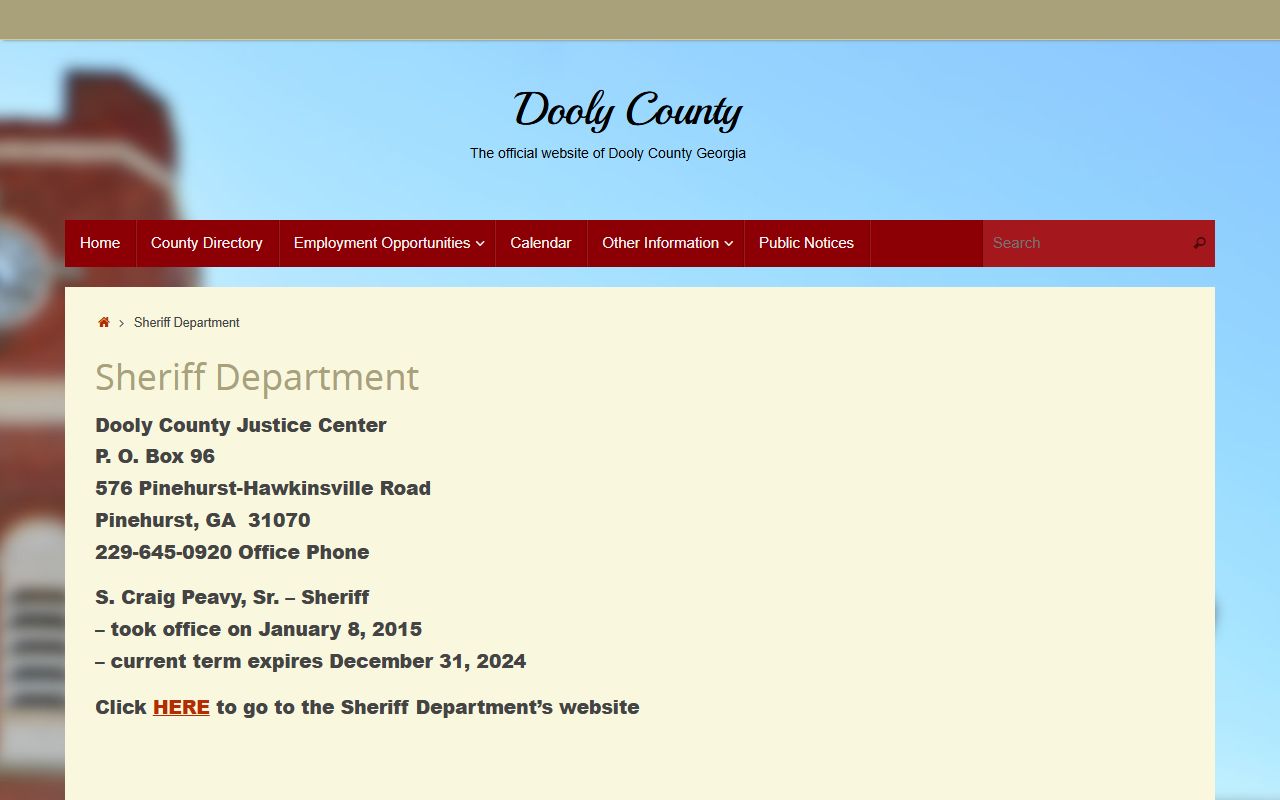
That sheriff source supports the arrest-record side of the arrest-to-charge path before a filed criminal case reaches court records.
Find Dooly County Arrest Records
Because no official Dooly County online booking roster was found, the local access chain starts with the Sheriff's Office. The sheriff contact page gives written correspondence to Sheriff Craig Peavy, Dooly County Sheriff's Office, P.O. Box 96, Pinehurst, GA 31070, the Justice Center street address at 576 Pinehurst Hawkinsville Road, Pinehurst, Georgia 31070, office phone (229) 645-0920, and fax (229) 645-0949. Booking, arrest, incident, jail, warrant, and civil-process records may be requested from the sheriff subject to Georgia Open Records Act limits.
- For arrest or booking material, contact the Dooly County Sheriff's Office at the Justice Center.
- For filed court charges, confirm whether the case is in Dooly Superior Court through Georgia Courts e-access and PeachCourt.
- Use the Clerk of Superior Court for certified criminal case records or missing court documents.
- Use the Cordele Judicial Circuit District Attorney for prosecutor-side charge or restriction questions when the research supports that route.
- Use Probate Court or the issuing court if the charge began as a traffic citation or missed citation date.
The Dooly Sheriff's Office contact page documents the mailing address, Justice Center address, phone, and fax for local arrest-record requests.
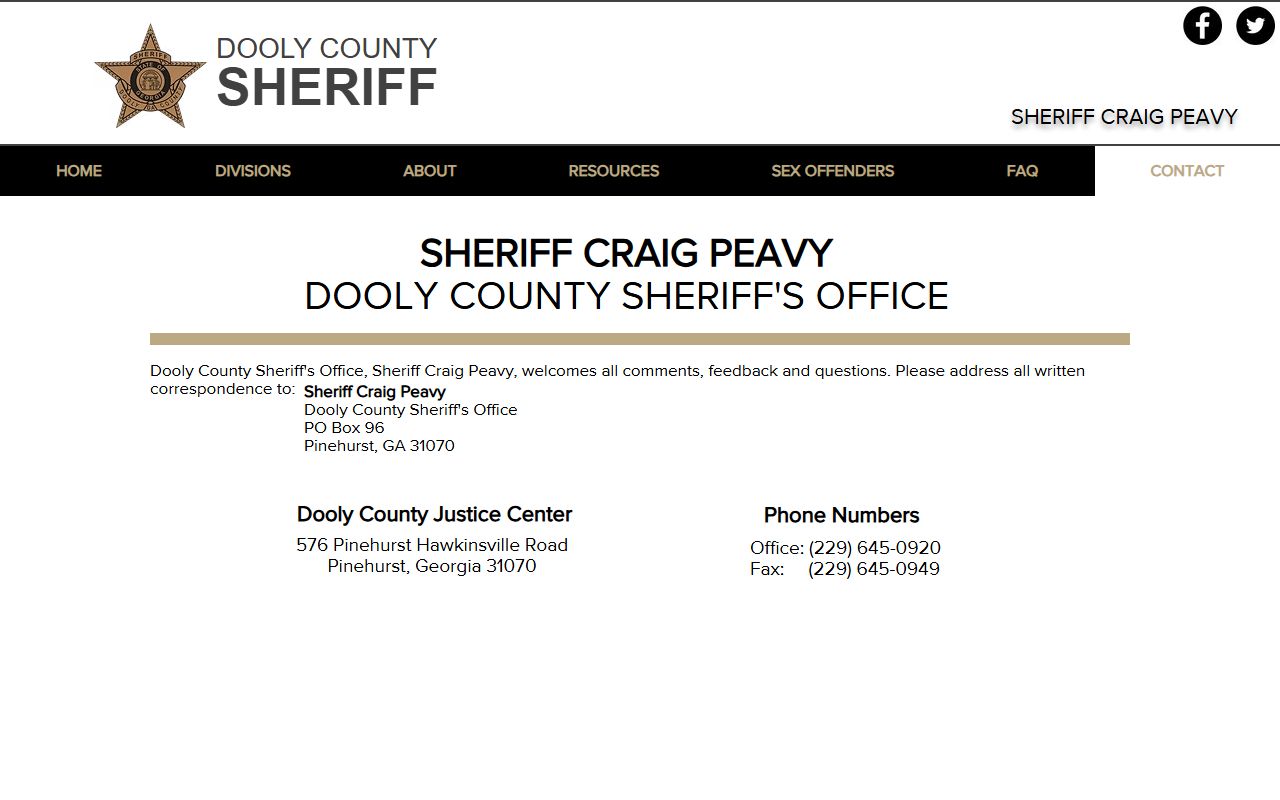
The contact source is especially important because the official sheriff pages did not expose a public Dooly booking search.
Charges After Arrest in Dooly County
After an arrest, the court-charge record depends on the charging document and court. The research identifies the Cordele Judicial Circuit District Attorney as the prosecutor for Dooly Superior Court cases. Prosecutors file accusations, present indictments, negotiate pleas, decide dismissals, and decide nolle prosequi. Magistrate Court may be involved in warrants and preliminary proceedings. Probate Court may be involved when the event is a traffic citation handled through that office. One arrest can lead to no filed charge, one filed charge, or several separate charges.
| Complaint | Information / Accusation | Indictment | |
|---|---|---|---|
| Filed By | Officer or prosecutor depending on the case stage | Prosecutor | Grand jury through the prosecutor |
| Common Use | Initial allegation or lower-court filing | Prosecutor-filed criminal charge | Serious felony charge path |
| Dooly Record Path | Sheriff, Magistrate, Probate, or case file depending on source | Superior Court criminal file when filed there | Superior Court criminal file |
Dooly County Charge Status
Charge status changes as the case moves. A pending charge is still open. An amended charge has changed from an earlier form. A reduced charge is less serious than the original filing. A dismissed charge has been ended by the court or prosecution. Nolle prosequi means the prosecutor decided not to pursue the charge. Dooly court charge records may show those changes as docket entries, amended filings, orders, or disposition fields.
| Status | What It Means |
|---|---|
| Pending | The charge remains open and has not reached final disposition. |
| Amended / reduced | The filed charge changed in wording, count, or severity during prosecution. |
| Dismissed | The court or prosecutor ended the charge without a conviction on that count. |
| Nolle prosequi | The prosecutor chose not to proceed with the charge. |
| Convicted | A guilty plea, verdict, or judgment produced a conviction and sentence entry. |
Dooly Charges vs. Convictions
A charge is an allegation filed by the government. A conviction is a court outcome. Dooly County arrest records can show arresting-agency allegations before any final case outcome exists. Dooly court charge records can show charges that were later reduced, dismissed, nolle prossed, or resolved by plea or trial. Always read the disposition before treating a charge as a conviction.
| Charge | Conviction | |
|---|---|---|
| Record stage | Arrest, warrant, citation, accusation, or indictment stage | Final court outcome on guilt |
| Meaning | The offense was alleged or filed | The court accepted or found guilt |
| Can change | May be amended, reduced, dismissed, or nolle prossed | May be appealed or later affected by restriction or court order |
Statewide Charge History Limits
Georgia criminal-history restriction is governed by O.C.G.A. 35-3-37 and summarized by the Georgia Bureau of Investigation. The Dooly research says qualifying post-July 1, 2013 arrests are handled through the prosecutor, while older arrests use the arresting agency process. That means a Dooly arrest record may require the Sheriff's Office or city police agency for older restriction steps, while a newer qualifying arrest may require the Cordele Judicial Circuit prosecutor. A restricted criminal-history record can remain available to criminal-justice agencies even if it is hidden for other purposes.
Note: Restricting a Georgia criminal-history entry is different from sealing a Dooly Superior Court case file.
Sealed and Restricted Charge Records
Juvenile charge records are restricted under Georgia juvenile laws. Adoption, mental-health, sealed, and minor-related material can also be closed or redacted. Pending law-enforcement and prosecution records may be withheld under Georgia Open Records Act exemptions, although initial arrest and incident reports receive separate treatment. In Dooly County, the custodian depends on the record: sheriff for arrest or booking records, prosecutor for charging decisions and some restriction approvals, and clerk for filed Superior Court records.
| Restricted History | Sealed Court Charge | |
|---|---|---|
| Main source | GBI and prosecutor or arresting agency process | Court file access law or court order |
| Record affected | Criminal-history information for non-criminal justice purposes | Public access to the filed court record |
| Dooly contact | District Attorney for newer qualifying arrests or sheriff for older arresting-agency path | Clerk of Superior Court and the judge assigned to the case |
Related Dooly Arrest Records
The sheriff's sex-offender page is not an arrest or court-charge database, but it is a law-enforcement record channel documented in the Dooly research. It describes the local registry and links to SheriffAlerts. Covered sex-offense records are governed by separate registration rules, not by the ordinary arrest-to-charge path. Use that record set only for sex-offender registry information, not as proof of a new arrest, current custody, or a current Dooly court charge.
The Dooly Sheriff's sex-offender information page is the successful manifest source tied to this related law-enforcement record channel.
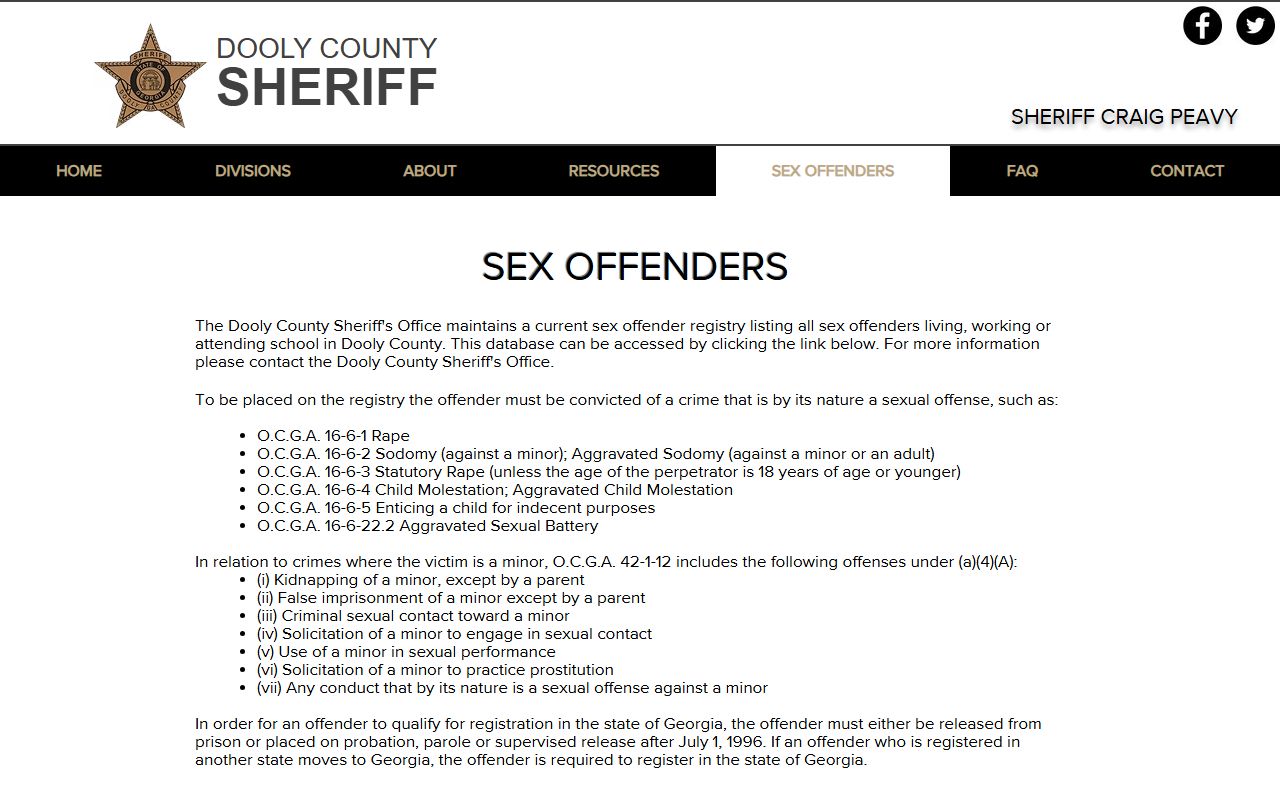
The registry page belongs in the law-enforcement record context, but it should not be mixed up with active jail booking or pending court charges.
Public Access to Dooly Charges
Dooly County arrest records and court charge records follow Georgia's public-record framework, but each record type has its own limits. Open-record requests for booking, arrest, incident, jail, and warrant material go to the Sheriff's Office when that office holds the record. Filed Superior Court charges go through the Clerk of Superior Court and the account-based PeachCourt route when online access is available. Prosecutor records may be limited by pending prosecution and work-product rules, even though prosecutor decisions appear in public court dockets once filed.
Charge records can also be tied to traffic citations, warrants, and probation matters. A traffic citation handled by Dooly Probate Court may use Probate Court and EZCourtPay channels. A bench warrant for failure to appear may require the issuing court and Sheriff's Warrants & Civil Division. A probation revocation may appear in the Superior Court criminal case file. The most accurate search path starts with the event type, then follows the custodian that created or filed the record.